

Offline-First Lesson Delivery.
How to keep classrooms running when bandwidth, power and connectivity aren't a given.

Abstract
Digital learning has become a central component of educational transformation strategies worldwide. Governments, ministries of education, development agencies, and technology providers increasingly view digital infrastructure as essential for improving learning outcomes, supporting teachers, expanding educational access, and preparing students for participation in modern economies. Yet much of the global conversation surrounding educational technology continues to assume that classrooms operate within environments characterized by reliable connectivity, stable electricity, abundant devices, and uninterrupted access to cloud-based services.
For many schools across Africa, the Middle East and North Africa (MENA), South Asia, Southeast Asia, and remote regions globally, these assumptions do not reflect operational reality. Connectivity remains inconsistent, bandwidth costs remain significant, power outages remain common, and access to technical support is often limited. Under such conditions, cloud-dependent educational systems can quickly become unreliable, disrupting lesson delivery, reducing teacher confidence, and undermining long-term adoption.
This paper examines the concept of offline-first lesson delivery and argues that resilience, rather than connectivity, should become the primary design principle for modern classroom infrastructure in emerging markets. It explores the technical, operational, and policy considerations required to maintain continuity of teaching and learning when internet access, electrical power, and cloud services cannot be assumed. Particular attention is given to hybrid cloud-edge architectures, local content distribution, offline synchronization, intelligent caching, edge AI, curriculum localization, and teacher workflow continuity.
Drawing upon recent research from UNESCO, UNICEF, OECD, GSMA, Gartner, the World Bank, and other international organizations, the paper argues that the future of educational technology in emerging markets will not be defined by permanently connected systems. Instead, it will increasingly be shaped by infrastructure capable of operating independently when necessary while synchronizing intelligently when connectivity becomes available. Ultimately, the paper concludes that offline-first lesson delivery is not a compromise or fallback strategy. It is increasingly becoming a foundational requirement for scalable, equitable, and sustainable educational transformation.
Introduction
For more than two decades, digital education strategies have largely been built around a simple assumption: connectivity improves over time.
This assumption has generally been correct. Internet access has expanded dramatically across much of the world. Mobile connectivity has accelerated. Device costs have fallen. Cloud computing has become increasingly accessible. Educational platforms have become more sophisticated and more widely adopted.
However, a critical distinction remains between connectivity being available and connectivity being dependable.
Many schools across emerging markets continue to experience operational challenges including:
- Intermittent internet access.
- Low bandwidth.
- High data costs.
- Electrical instability.
- Limited technical support.
- Shared device environments.
- Geographic isolation.
UNICEF's 2024 report on digital equity highlights that significant disparities remain in access to reliable digital infrastructure, particularly across rural and underserved communities (UNICEF, 2024).
Meanwhile, UNESCO's Global Education Monitoring Report emphasizes that technology initiatives frequently fail when they rely upon infrastructure assumptions that do not reflect local conditions (UNESCO, 2023).
The consequence is increasingly visible in classrooms.
- Teachers plan lessons around cloud platforms that fail to load.
- Students lose access to digital resources during connectivity outages.
- Interactive content becomes unavailable.
- Assessment systems stop functioning.
- Entire lessons become dependent on whether internet infrastructure performs as expected.
This raises a fundamental question:
Increasingly, the answer is that educational systems must be designed differently.
Rather than treating offline capability as an exception, future educational infrastructure may need to assume that connectivity interruptions are normal operational conditions.
This is the foundation of offline-first lesson delivery.
1. The Connectivity Myth
The phrase "connected classroom" has become one of the most widely used concepts within educational technology.
However, the term often creates unrealistic expectations.
Connectivity is frequently discussed as though it exists in binary terms:
- Connected.
- Not connected.
In reality, connectivity exists across a spectrum.
A school may technically have internet access while simultaneously experiencing:
- High latency.
- Frequent dropouts.
- Bandwidth congestion.
- Data affordability challenges.
- Power interruptions.
GSMA's 2024 Mobile Economy report demonstrates that significant variations continue to exist in network quality across emerging markets, particularly between urban and rural regions (GSMA, 2024).
This creates a common deployment problem.
Technology systems may function effectively in:
- Demonstration environments.
- Urban pilot schools.
- Ministry headquarters.
- High-bandwidth testing facilities.
Yet struggle during deployment across:
- Rural districts.
- Remote communities.
- Underserved regions.
- Disaster-affected areas.
The result is often a loss of teacher confidence.
When teachers cannot depend on systems functioning consistently, adoption declines rapidly.
The issue is not simply technological.
It is operational.
- Teachers require certainty.
- Learning requires continuity.
- Classrooms require reliability.
Offline-first architectures address these requirements directly by prioritizing continuity rather than connectivity.
2. Why Lesson Delivery Must Be Resilient
The primary purpose of educational infrastructure is not technological innovation.
Its purpose is instructional continuity.
Students learn through consistent engagement with curriculum, teaching, assessment, and feedback. Every interruption to that continuity introduces risk.
Research from the World Bank continues to demonstrate the importance of instructional continuity in reducing learning loss and improving long-term educational outcomes (World Bank, 2023).
This becomes particularly important in environments where external factors already create educational disruption.
These may include:
- Infrastructure limitations.
- Geographic isolation.
- Climate-related events.
- Political instability.
- Resource constraints.
In such environments, lesson delivery systems must function as resilient infrastructure rather than dependent services.
A resilient lesson delivery system should be capable of continuing operation when:
- Internet access fails.
- Cloud services become unavailable.
- Network congestion occurs.
- Bandwidth is restricted.
- Connectivity costs become prohibitive.
This requires a different architectural mindset.
Rather than designing around ideal operating conditions, systems must increasingly be designed around real-world conditions.
3. What Does Offline-First Actually Mean?
Offline-first is often misunderstood as simply downloading content in advance.
In reality, offline-first is an architectural philosophy.
An offline-first educational system assumes that core teaching and learning activities should continue regardless of connectivity status.
This includes:
- Lesson presentation.
- Curriculum access.
- Student activities.
- Assessments.
- Resource libraries.
- Teacher planning tools.
- Learning analytics collection.
Connectivity becomes an enhancement rather than a dependency.
Offline-first systems typically incorporate several capabilities:
Local Content Storage
Educational resources are stored locally rather than streamed continuously.
Intelligent Synchronization
Data synchronizes automatically when connectivity becomes available.
Local User Authentication
Teachers and students can access systems without requiring constant cloud validation.
Distributed Content Delivery
Resources can be shared locally across devices within classrooms or schools.
Local AI Inference
Certain intelligent functions operate without requiring remote cloud services.
The result is a system capable of maintaining continuity even when external infrastructure becomes unavailable.
4. The Rise of Edge Computing in Education
One of the most significant developments enabling offline-first lesson delivery is the emergence of edge computing.
Traditionally, educational platforms relied heavily upon centralized cloud infrastructure.
- Every interaction required communication with remote servers.
- Every lesson depended upon network connectivity.
- Every resource request generated bandwidth demand.
Edge computing changes this model.
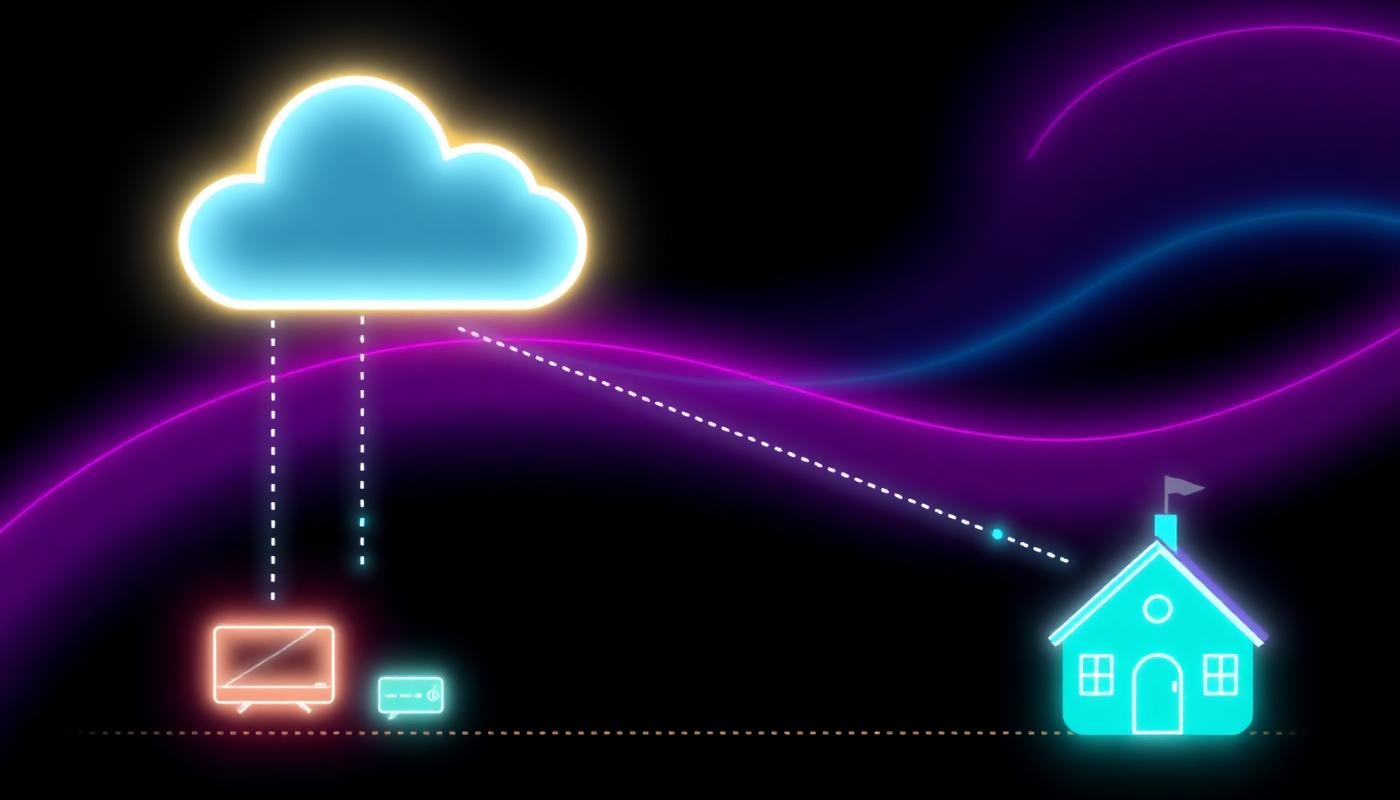
Gartner's 2024 technology trends report identifies distributed AI and edge intelligence as key developments shaping future digital infrastructure (Gartner, 2024).
Within education, edge systems place computing resources closer to classrooms.
This may include:
- School-level servers.
- Classroom devices.
- Local microcloud environments.
- Edge AI appliances.
The benefits are substantial:
Reduced Bandwidth Requirements
Content is delivered locally.
Faster Response Times
Resources load instantly.
Improved Reliability
Lessons continue regardless of internet status.
Lower Operating Costs
Bandwidth consumption decreases.
Increased Sovereignty
Data remains under local control.
For emerging markets, these advantages are particularly significant.
Edge infrastructure effectively brings intelligence closer to where learning actually occurs.
5. Power Resilience Matters as Much as Connectivity
Connectivity discussions often overlook another critical issue:
Electricity.
Many educational technology strategies assume stable power availability.
Yet power interruptions remain common across many regions globally.
According to the International Energy Agency, hundreds of millions of people continue to experience unreliable electricity access, particularly across parts of sub-Saharan Africa and developing Asia (IEA, 2024).
For schools, this has major implications.
Educational systems must increasingly consider:
- Battery-backed devices.
- Low-power hardware.
- Energy-efficient computing.
- Local power redundancy.
- Solar integration opportunities.
Modern lesson delivery systems should not require enterprise-level infrastructure to remain operational.
Instead, resilience should be designed into the system from the outset.
Power resilience and connectivity resilience increasingly need to be treated as interconnected challenges.
6. AI Must Work Offline Too
As artificial intelligence becomes increasingly integrated into education, a new challenge emerges.
Most AI systems remain heavily dependent on cloud infrastructure.
This creates problems in environments where connectivity cannot be guaranteed.
Educational AI functions increasingly include:
- Lesson generation.
- Resource recommendations.
- Assessment support.
- Translation.
- Student assistance.
- Teacher planning.
If these capabilities disappear during connectivity interruptions, educational workflows become fragile.
Fortunately, advances in model efficiency are creating new possibilities.
Smaller language models and edge AI architectures increasingly allow certain intelligent functions to operate locally.
NVIDIA's 2024 Sovereign AI framework highlights the growing importance of local inference capability across education, government, and public services (NVIDIA, 2024).
For education systems, this means:
- Curriculum resources can remain accessible.
- Teacher assistance functions can continue operating.
- Learning support tools remain available.
- Classroom workflows remain uninterrupted.
The future of educational AI in emerging markets will likely be hybrid:
- Cloud-enhanced when available.
- Locally operational when required.
7. Teachers Need Confidence, Not Complexity
Technology adoption ultimately depends on trust.
Teachers are unlikely to integrate systems deeply into instructional practice if they believe those systems may fail during lessons.

This creates an important insight.
Offline-first infrastructure is not simply a technical feature.
It is a confidence-building mechanism.
When teachers know that:
- Resources are available locally.
- Lessons will load instantly.
- Connectivity interruptions will not disrupt teaching.
- Student work will synchronize later.
...they become more willing to incorporate technology into daily workflows.
Education International's 2023 research on teacher wellbeing highlights the importance of reducing operational uncertainty within increasingly complex educational environments (Education International, 2023).
Reliability directly supports adoption.
And adoption ultimately determines impact.
8. Offline-First Supports Educational Equity
Educational technology often risks reinforcing inequality when it depends heavily on infrastructure availability.
Students in:
- Urban schools.
- High-income communities.
- Well-connected regions.
...may receive significantly different experiences from students in rural or underserved areas.
UNESCO continues to emphasize that digital transformation strategies must prioritize equity alongside innovation (UNESCO, 2023).
Offline-first architectures support equity by reducing dependence on external infrastructure conditions.
Every school receives access to:
- The same curriculum.
- The same resources.
- The same learning opportunities.
Regardless of network quality.
This is particularly important for national education systems seeking consistent educational delivery across diverse geographic regions.
Offline capability therefore becomes not only an infrastructure decision, but also an equity strategy.
9. The Future Classroom Is Hybrid
The future classroom is unlikely to be permanently offline.
Nor is it likely to be permanently cloud-dependent.
Instead, the most effective educational environments will increasingly combine both approaches.
Hybrid architectures offer:
Cloud Advantages
Central management. Updates. Analytics. Collaboration.
Local Advantages
Reliability. Speed. Continuity. Sovereignty. Resilience.
This model increasingly mirrors broader trends across enterprise computing, healthcare, government, and industrial systems.
The objective is not to eliminate cloud services.
The objective is to remove dependence upon them for critical instructional activities.
When connectivity becomes an enhancement rather than a requirement, educational systems become significantly more resilient.
Conclusion
Offline-first lesson delivery is often misunderstood as a solution for low-connectivity environments alone.
In reality, it represents a broader shift toward resilient educational infrastructure.
As schools increasingly integrate digital content, AI-supported learning, analytics, and connected classroom technologies, operational continuity becomes more important than ever.
- Classrooms cannot pause because bandwidth is unavailable.
- Learning cannot stop because cloud services are inaccessible.
- Teachers cannot redesign lessons every time infrastructure fails.
Educational systems must therefore be designed around reliability first.
Offline-first architectures provide a framework for achieving this by ensuring that:
- Lessons remain accessible.
- Resources remain available.
- AI support remains operational.
- Learning continues uninterrupted.
Across Africa, MENA, Asia-Pacific, and other emerging regions, this approach may prove critical to achieving equitable and sustainable digital transformation.
Because ultimately, the most important measure of educational infrastructure is not how advanced it appears when networks are functioning perfectly.
It is whether teaching and learning continue when they are not.
Bibliography
- Education International (2023) Teacher Wellbeing and Burnout in Developing Education Systems. Brussels: Education International.
- Gartner (2024) Top Strategic Technology Trends 2024: Distributed AI and Edge Intelligence. Stamford, CT: Gartner Research.
- GSMA (2024) The Mobile Economy Sub-Saharan Africa 2024. London: GSMA Intelligence.
- International Energy Agency (IEA) (2024) Energy Access Outlook 2024. Paris: IEA.
- NVIDIA (2024) What Is Sovereign AI?. Santa Clara, CA: NVIDIA Corporation.
- OECD (2023) Digital Education Outlook 2023: Towards an Effective Digital Education Ecosystem. Paris: OECD Publishing.
- UNESCO (2023) Global Education Monitoring Report 2023: Technology in Education — A Tool on Whose Terms?. Paris: UNESCO.
- UNICEF (2024) The State of the World's Children 2024: Education and Digital Equity. New York: UNICEF.
- World Bank (2023) Ending Learning Poverty and Building Skills: Investing in Education Systems. Washington DC: World Bank.
- World Economic Forum (2024) Shaping the Future of Learning: Artificial Intelligence and Education Systems. Geneva: World Economic Forum.