
Edge AI, Small Language Models and the End of Hyperscale Dependence
Why the future of artificial intelligence may fit in the palm of your hand — and what recent announcements from Microsoft, NVIDIA and Google mean for emerging countries.
Abstract
For much of the recent AI cycle, artificial intelligence has been framed as a hyperscale infrastructure race. Larger models, larger GPU clusters, larger data centres and larger cloud budgets dominated the narrative. That model remains important, particularly for frontier training and the most complex reasoning systems. However, the last few weeks have made clear that the industry is also moving decisively in another direction: distributed intelligence.
Recent announcements from Microsoft and NVIDIA signal a shift from cloud-only AI toward local inference, agentic devices, AI PCs, compact AI workstations and small-to-medium models that can run closer to the user. Microsoft's Build 2026 announcements included its own MAI-Thinking-1 reasoning model, Scout personal agent, Microsoft IQ context layer, Project Solara for agent-first devices, and the Surface RTX Spark Dev Box, a compact NVIDIA-powered AI developer machine capable of running large models locally. NVIDIA's Computex 2026 announcements around RTX Spark and its roadmap for AI PCs and mini workstations similarly point toward a future where serious AI capability moves beyond hyperscale servers and into local devices, developer workstations and edge environments.
This matters profoundly for emerging countries. Africa, MENA, South Asia and Asia-Pacific cannot wait for every school, clinic, municipality and rural community to be connected to hyperscale cloud AI. Bandwidth remains uneven, data costs remain material, power conditions vary, and sovereign control over national data, language and curriculum is becoming increasingly important. Edge AI and small language models offer a different pathway: practical intelligence delivered locally, affordably and resiliently.
This paper argues that the next phase of AI will not be defined only by the largest models. It will increasingly be defined by who can deploy useful intelligence where people actually are. In this context, NDX is positioned at the forefront of a major market transition: building distributed, offline-first, education-specific AI infrastructure for environments where connectivity, cost and sovereignty matter as much as raw model scale.

Introduction
The first public phase of generative AI was dominated by scale. Model capability was associated with parameter count, training data, GPU availability and cloud capacity. The assumption was straightforward: better AI meant bigger models and bigger infrastructure.
That assumption is now being challenged.
Microsoft, NVIDIA and Google are all moving toward a more distributed AI architecture. The industry is not abandoning hyperscale AI, but it is increasingly recognizing that hyperscale alone cannot deliver intelligence everywhere. The new direction is hybrid: frontier models in the cloud, smaller models on devices, agentic systems on personal hardware, and edge inference close to where work happens.
Microsoft's latest Build announcements are particularly important because they show the company moving beyond cloud-hosted copilots into agentic, local and device-level AI. MAI-Thinking-1, Microsoft's new in-house reasoning model, is described publicly as a medium-sized reasoning model rather than a frontier-scale system, while MAI-Code-1-Flash is positioned as inference-efficient and integrated into developer workflows. Microsoft also introduced Project Solara, an operating system concept for agent-first devices, indicating that AI is being designed into new hardware categories rather than simply added to existing cloud applications.
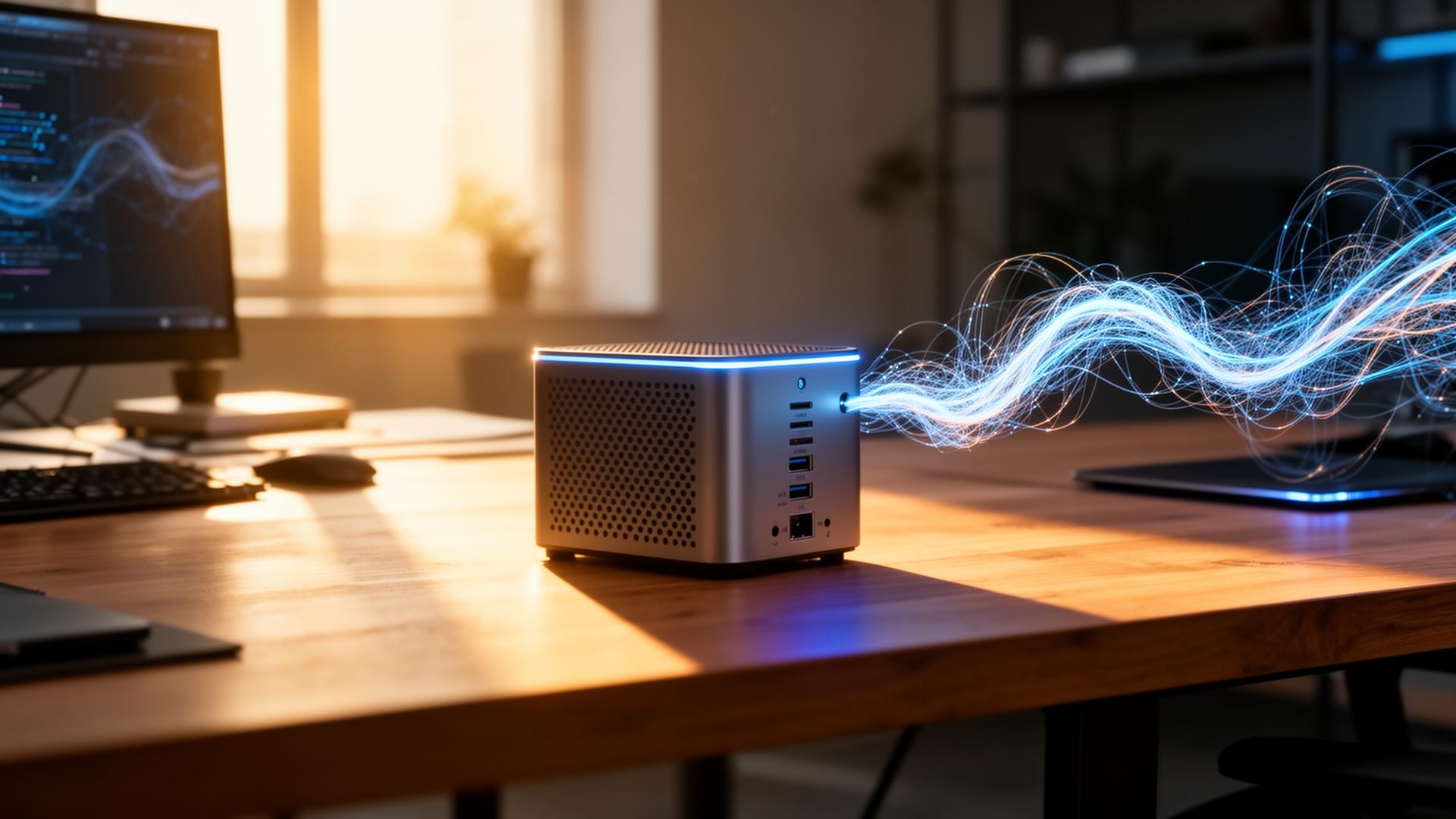
NVIDIA's recent RTX Spark announcements reinforce the same direction from the hardware side. RTX Spark brings a Grace Blackwell-based AI system-on-chip approach into Windows PCs, laptops and mini-PCs, with public reports describing one petaflop of AI compute and 128GB of unified memory in compact systems designed for local AI workloads. Microsoft's Surface RTX Spark Dev Box extends this trend, positioning a compact desktop AI machine as a developer platform for local model execution, fine-tuning and agentic workloads.
This is not a marginal shift. It is the early structure of a new AI deployment model.
The question is no longer simply: who can build the largest model?
The more important question is becoming: who can make intelligence available reliably, affordably and locally?
For emerging countries, that question is decisive.
1. The Limits of the Hyperscale-Only Model
Hyperscale AI will remain essential. Frontier model training, large-scale multimodal reasoning, advanced coding systems and scientific discovery workloads will continue to require massive compute infrastructure.
However, hyperscale AI is not a complete deployment strategy.
For governments, schools, hospitals and public services in emerging markets, cloud-only AI creates several structural challenges. First, it assumes reliable internet access. Second, it creates ongoing inference costs. Third, it can move sensitive national data into foreign infrastructure. Fourth, it risks excluding rural and low-bandwidth communities. Fifth, it concentrates AI capability in the hands of a small number of global platform providers.
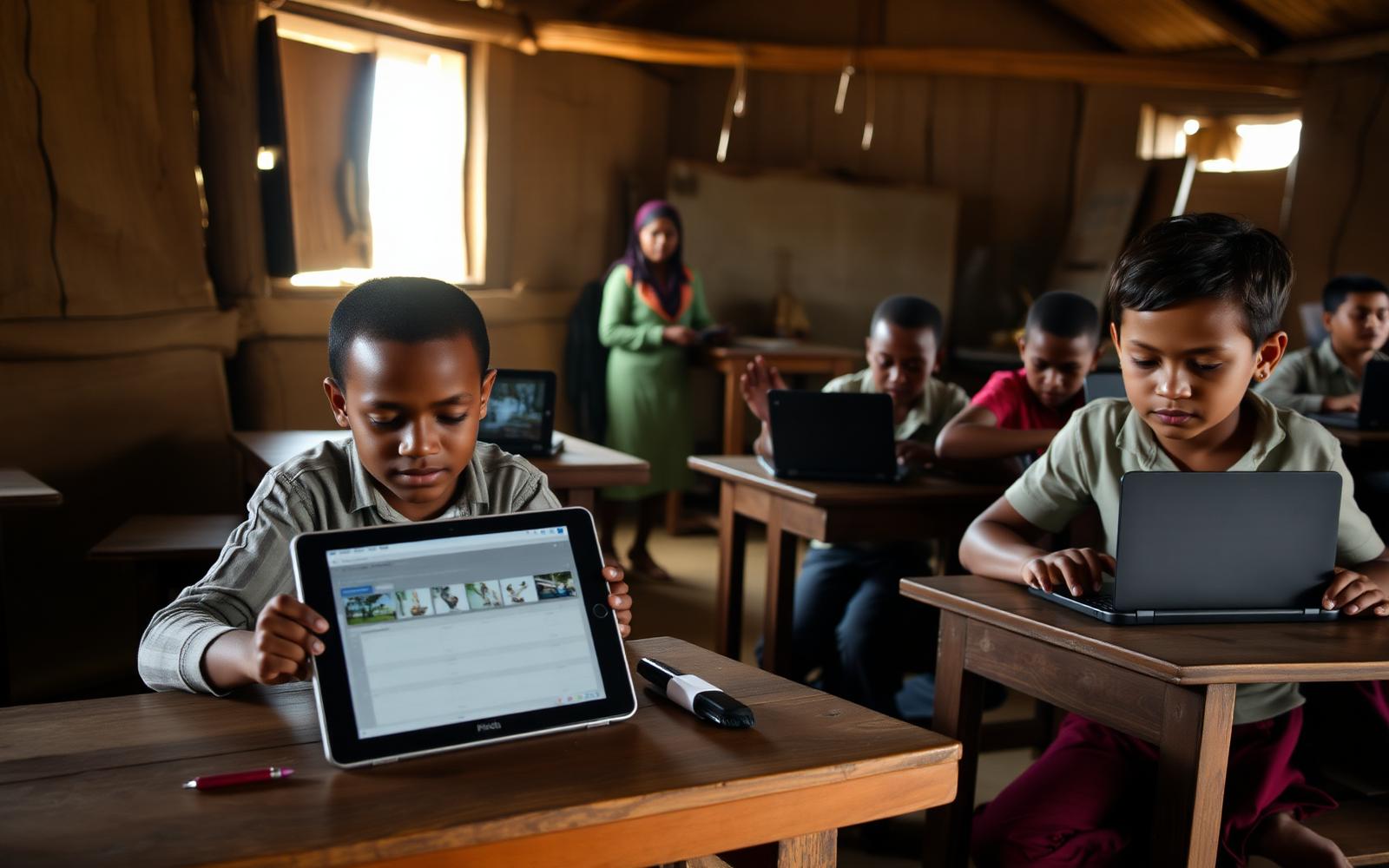
This is especially problematic for education. Classrooms cannot depend entirely on distant data centres when lessons need to run every day, regardless of network conditions. Teachers need systems that work during the lesson, not only when bandwidth is stable. Students need access to curriculum-aligned support even when cloud services are unavailable.
The same logic applies to healthcare, agriculture, municipal government, public safety and workforce development. Intelligence needs to exist at the point of need.
This is where edge AI changes the strategic equation.
Edge AI does not replace cloud AI. It complements it. The cloud remains useful for updates, large-scale training, analytics, central management and advanced model access. But the edge provides local continuity, speed, privacy and resilience.
For emerging countries, that distinction is the difference between AI as a premium cloud service and AI as practical national infrastructure.
2. Microsoft's Recent Announcements: Local Agents, Medium Models and AI Devices
Microsoft's latest announcements matter because they show one of the world's largest cloud and productivity companies moving toward local, agentic and device-level AI.
At Build 2026, Microsoft introduced MAI-Thinking-1, its own reasoning model, alongside other in-house models including MAI-Code-1-Flash, MAI-Transcribe-1.5, MAI-Voice-2 and MAI-Image 2.5. Public reporting describes MAI-Thinking-1 as a medium-sized reasoning model, while MAI-Code-1-Flash is positioned around inference efficiency for coding workflows.
This is strategically important. Microsoft is not only pursuing bigger cloud models. It is building specialized models with efficiency, workflow integration and deployment practicality in mind.
Microsoft also announced Scout, a personal AI agent built around contextual understanding and work data, and Microsoft IQ, a context layer designed to ground agents in workspace information and web signals. This points toward a broader shift from generic assistants to context-aware agents. In practical terms, the value is not just the model. The value is the combination of model, memory, retrieval, context and workflow.
Project Solara extends the argument further. It is described as a platform for AI-powered agent devices, using a Microsoft Device Ecosystem Platform rather than conventional Windows, and aimed at low-power agent-first hardware. That matters because it indicates that Microsoft sees AI moving into new device categories, not remaining confined to desktop software or cloud interfaces.
The Surface RTX Spark Dev Box is another major signal. Public reporting describes it as a compact NVIDIA-powered AI developer machine with 128GB of unified memory and one petaflop of AI compute, capable of running models locally rather than depending entirely on the cloud.
Together, these announcements say something very clear: Microsoft is preparing for an AI future where agents, local models, device-level inference and compact AI hardware become central.
That is exactly the direction emerging market infrastructure needs.
3. NVIDIA's Recent Announcements: From GPU Supplier to Edge AI Platform Company
NVIDIA has long been associated with hyperscale GPUs, but its recent RTX Spark direction shows a broader ambition. NVIDIA is not only powering data centres. It is moving AI compute into PCs, laptops, mini workstations and edge devices.
At Computex 2026, NVIDIA outlined the RTX Spark platform and roadmap for AI PCs and desktop systems, including future Spark generations based on Rubin and later Rosa Feynman. Public reporting describes RTX Spark as a GB10-based system-on-chip integrating CPU, Blackwell GPU capability and unified memory into compact Windows PC hardware.
This is important because it changes where serious AI work can happen.
Historically, AI development and inference at scale required either a cloud instance or a powerful workstation with discrete GPUs. RTX Spark and DGX Spark-style systems point toward compact, local AI machines that can sit on a desk, in a school, in a lab, or inside a small institutional environment.
Reports describe DGX Spark as a compact desktop AI supercomputer using the GB10 Grace Blackwell Superchip, with 128GB unified memory and support for large local models through FP4 quantization. Microsoft's Surface RTX Spark Dev Box reflects this same hardware direction being pulled into the Windows and developer ecosystem.
This is not simply "more GPU power." It is a new category of local AI infrastructure.
For emerging countries, the relevance is substantial. A school, district, ministry department, clinic or local government office may not be able to operate a hyperscale data centre. But it may be able to operate compact local AI infrastructure, especially if paired with small language models, local retrieval systems and offline-first workflows.
The significance is not that every classroom needs an RTX Spark device. The significance is that the industry's hardware direction now validates local AI compute as a serious architectural layer.
4. Google's Direction: On-Device Models and Lightweight AI
Google has also been moving in the direction of efficient and distributed AI. The Gemma family demonstrates Google's commitment to smaller, deployable open models, with Gemma models designed for practical developer use and local execution scenarios. Publicly available summaries describe Gemma 3 as supporting 1B, 4B, 12B and 27B sizes, while Gemma 3n is identified as being optimized for phones, laptops and tablets.
Google's Gemini Nano direction is equally important. Research and developer experimentation around Chrome's built-in Gemini Nano shows how browser-level AI can operate without external API dependencies, although with constraints such as limited context windows.
This is the key point: AI is moving into the operating system, the browser and the device.
Google's wider Gemini strategy also shows a move toward multiple model classes: advanced cloud reasoning models, faster cost-optimized models, and lightweight models for device-level experiences. Public reporting and summaries of Google's Gemini roadmap show cost-efficient Flash and Flash-Lite variants alongside more advanced reasoning models.
For emerging market education, this matters because smaller, optimized models do not need to replicate the full capability of frontier cloud models to be useful. A classroom does not always need a universal reasoning engine. It often needs reliable curriculum support, translation, planning assistance, retrieval from local content, assessment explanation and teacher workflow automation.
Those are precisely the kinds of workloads where smaller models, retrieval and orchestration can deliver major value.
5. Small Language Models Are No Longer Second-Class AI
The phrase "small language model" can be misleading. It suggests compromise. In reality, small language models are becoming a major deployment category.
Microsoft's Phi-3 technical report introduced Phi-3-mini as a 3.8 billion parameter model capable of strong benchmark performance while being small enough to deploy locally on a phone. Later Phi work extended this direction into compact multimodal models, showing that small architectures can support increasingly capable language and multimodal use cases.
The practical lesson is clear: model size is no longer the only determinant of usefulness.
In many real-world settings, performance depends on:
- the quality of the data
- the relevance of the model to the task
- retrieval and grounding
- orchestration
- local context
- latency
- cost
- reliability
- privacy
For education, this is especially important. A smaller model grounded in a national curriculum, local languages and teacher workflows may be more valuable in a classroom than a much larger generic model with no understanding of the local system.
This is the basis of the emerging "small model plus strong context" paradigm.
The model does not need to know everything. It needs access to the right knowledge, at the right time, in the right workflow.
6. Edge AI Is Not Just About Devices. It Is About Architecture.
Edge AI is sometimes misunderstood as simply running a model on a phone, tablet or laptop. That is only part of the story.
A real edge AI architecture includes:
- local compute
- local content storage
- local model inference
- local retrieval
- offline synchronization
- secure update mechanisms
- cloud escalation when required
- device management
- observability
- policy controls
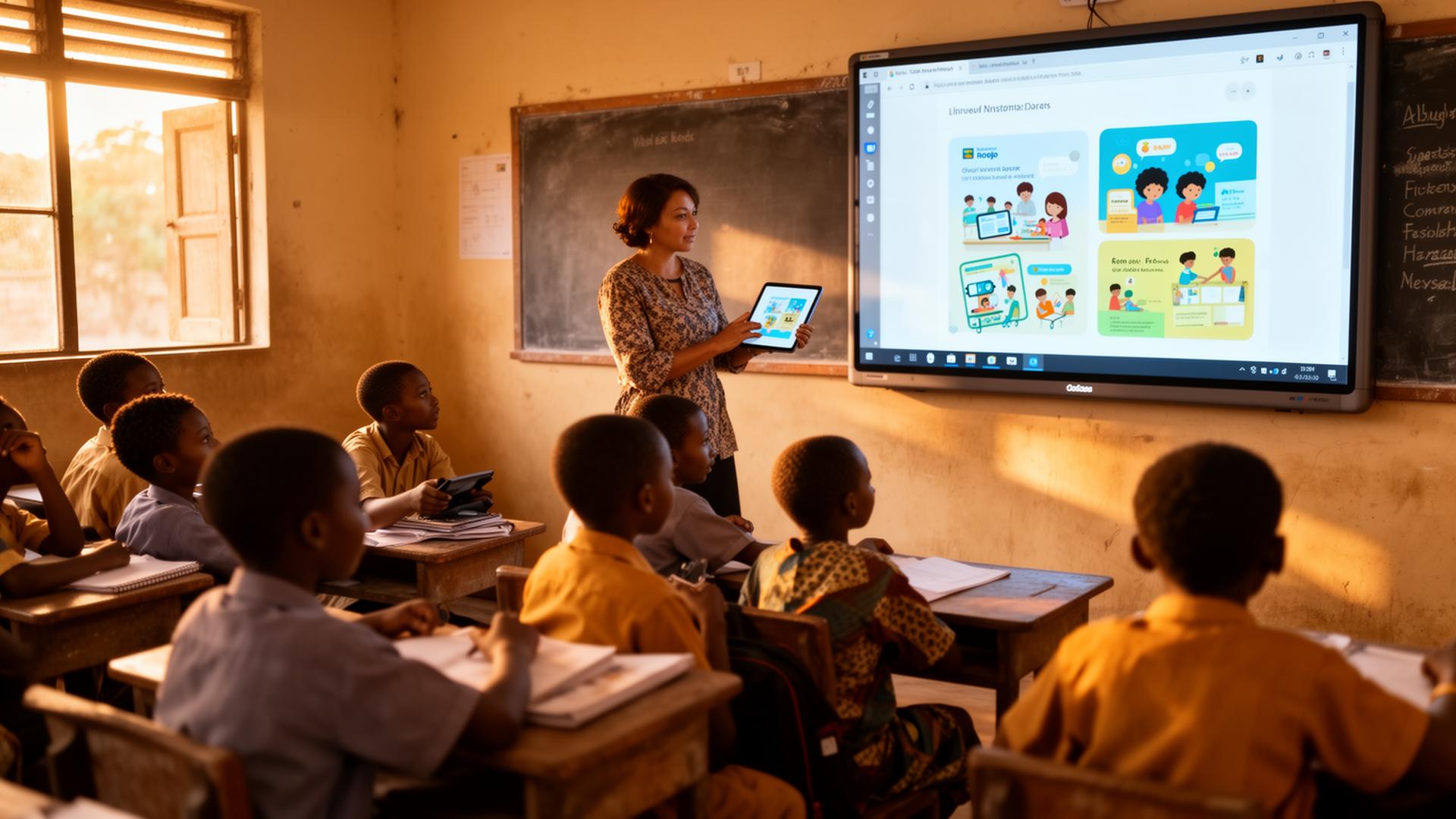
In education, this might mean a classroom or school has a local intelligence layer that stores curriculum resources, lesson content, teacher materials, assessment structures, language packs and small models. When the internet is available, the system synchronizes, updates and escalates complex tasks to the cloud. When the internet is unavailable, the core lesson experience continues.
This is the practical difference between cloud-first and offline-first AI.
Cloud-first AI asks the school to depend on infrastructure it may not control.
Offline-first edge AI asks the system to adapt to the conditions of the school.
For emerging countries, that difference is decisive.
7. Why This Matters for Emerging Countries
Emerging countries face a strategic AI choice.
They can become dependent consumers of foreign cloud intelligence, or they can build distributed national intelligence systems that operate across schools, clinics, public offices and local communities.
The first path is faster initially but creates dependency. The second path requires more architectural thinking but builds national capability.
Edge AI and small language models make the second path more realistic.
A country does not need to build a frontier model to benefit from sovereign AI. It can build:
- curriculum-grounded educational models
- local language assistants
- agricultural advisory systems
- healthcare triage support
- government service agents
- teacher support systems
- public-sector knowledge assistants
These can operate on smaller, optimized models supported by local retrieval and edge infrastructure.
This matters because emerging countries often have strong local knowledge but weak digitization. AI can help convert national knowledge into usable infrastructure. But that only happens if the AI systems are grounded in local data, language, culture and institutional workflows.
A generic global AI system may be powerful, but it does not automatically understand a country's curriculum, rural health practices, agricultural seasons, local dialects or ministry policy environment.
Sovereign edge AI allows countries to make intelligence local.
8. NDX and the Bleeding Edge of Distributed Educational Intelligence
This is where NDX's position becomes important.
The market is now moving toward the architectural assumptions NDX has been building around: edge intelligence, offline-first delivery, smaller education-specific models, local inference, curriculum grounding, sovereign deployment and practical classroom resilience.
NDX's core insight is that educational AI for emerging markets cannot be designed as a cloud-only product. It must be designed as infrastructure that works inside real schools.
That means:
- intelligence must be available even when connectivity fails
- lesson delivery must continue without cloud dependence
- teacher workflows must be supported locally
- curriculum resources must be accessible offline
- AI assistance must be grounded in national curriculum and local context
- countries must retain control over data, language and educational priorities
This is not a future abstraction. It is exactly where Microsoft, NVIDIA and Google are now moving in their own markets. Microsoft is pushing agents, local models and AI developer hardware. NVIDIA is pushing compact AI compute through RTX Spark and DGX Spark-class systems. Google is pushing lightweight models and on-device AI through Gemma and Gemini Nano.
NDX is applying this same movement to one of the hardest and most important sectors: education in emerging countries.
That is the strategic significance.
NDX is not simply adding AI features to classrooms. It is building the kind of distributed educational intelligence architecture that the wider AI industry is now validating.
9. The Education Use Case Is Different from Enterprise AI
Enterprise AI often assumes:
- stable connectivity
- managed devices
- IT teams
- secure cloud accounts
- predictable workflows
- high user digital maturity
Schools in emerging markets do not always have those conditions.
A teacher may have one interactive panel, shared student devices, intermittent bandwidth and limited technical support. A rural school may have power constraints. A ministry may need a system that works across thousands of classrooms with very different infrastructure realities.
This makes education one of the clearest use cases for edge AI.
The objective is not to run a massive general-purpose model in every classroom. The objective is to deliver the right intelligence at the point of teaching.
That means:
- lesson planning support
- adaptive pacing
- curriculum explanation
- local language support
- offline content access
- assessment guidance
- teacher-facing intelligence
- student support when appropriate
A 7B or 13B education-specific model, supported by local retrieval and curriculum memory, may be far more practical than a massive frontier model accessed through unstable connectivity.
In other words, the future of classroom AI may be less about model size and more about model placement.
10. The Palm-of-the-Hand AI Future
The phrase "AI in the palm of your hand" should not be understood as a gimmick. It describes a major infrastructure shift.
If AI can run locally on phones, tablets, laptops, mini-PCs and classroom devices, then intelligence can spread far beyond elite institutions.
That changes the economics of access.
A teacher in a rural school should not need to wait for a hyperscale cloud response to access a lesson explanation. A student should not lose support because a connection drops. A ministry should not have to choose between national AI capability and unsustainable cloud costs.
The convergence of small models, NPUs, compact AI chips, local inference and offline synchronization makes a different future possible.
It is a future where intelligence is:
- closer
- cheaper
- faster
- more private
- more sovereign
- more resilient
That is the real opportunity for emerging countries.
Conclusion
The last few weeks have materially strengthened the case for distributed AI.
Microsoft's Build 2026 announcements around MAI-Thinking-1, Scout, Microsoft IQ, Project Solara and the Surface RTX Spark Dev Box show a major technology company moving toward medium-sized reasoning models, agentic systems, local context and compact AI hardware. NVIDIA's Computex 2026 RTX Spark announcements show the hardware layer moving toward compact AI PCs and local developer systems capable of serious inference workloads outside hyperscale data centres. Google's Gemma and Gemini Nano direction reinforces the broader movement toward smaller, more deployable models and on-device intelligence.
The direction is now clear.
AI is not only getting bigger.
It is getting closer.
For emerging countries, this is the most important AI development of the moment. It means intelligence can be deployed into classrooms, clinics, local government offices and community environments without waiting for perfect cloud infrastructure.
NDX is at the forefront of this movement in education. Its focus on distributed educational intelligence, offline-first delivery, edge AI, curriculum-grounded models, local inference and sovereign deployment is not a side bet. It is aligned with where the world's largest AI companies are now moving.
The future of AI will not be measured only by the size of the largest models.
It will be measured by how effectively intelligence reaches people.
For emerging countries, the opportunity is not to copy the hyperscale model. The opportunity is to leapfrog toward distributed, sovereign, practical AI infrastructure.
That future is no longer theoretical.
It is arriving now.
Bibliography — Harvard Style
- Google DeepMind (2024) Gemma: Open Models Built from Gemini Research. London: Google DeepMind.
- Microsoft Research (2024) Phi-3 Technical Report: A Highly Capable Language Model Locally on Your Phone. Redmond, WA: Microsoft Research.
- Microsoft Research (2025) Phi-4-Mini Technical Report: Compact yet Powerful Multimodal Language Models via Mixture-of-LoRAs. Redmond, WA: Microsoft Research.
- The Verge (2026) 'Microsoft's first advanced reasoning AI is here'.
- The Verge (2026) 'Microsoft's Project Solara is an OS for AI agent gadgets'.
- Axios (2026) 'Microsoft debuts Scout agent, homegrown reasoning model'.
- Windows Central (2026) 'Microsoft IQ connects AI agents to your workspace data and the web'.
- Windows Central (2026) 'Microsoft is making a Surface mini PC for AI developers'.
- Tom's Hardware (2026) 'Microsoft debuts Surface RTX Spark Dev Box'.
- Tom's Hardware (2026) 'NVIDIA lays out RTX Spark roadmap for laptops and desktop PCs at Computex 2026'.
- Times of India (2026) 'RTX Spark is NVIDIA's superchip for Windows PCs'.
- Surulimuthu, V.V. and Rao, A.K.G. (2024) 'CAG: Chunked Augmented Generation for Google Chrome's Built-in Gemini Nano', arXiv preprint, December.
- Tummalapalli, P., Arayakandy, S., Pal, R. and Kundan, K. (2026) 'LLM Inference at the Edge: Mobile, NPU, and GPU Performance Efficiency Trade-offs Under Sustained Load', arXiv preprint, March.