

One Platform Beats Ten Apps — Especially Where Connectivity Is Scarce
Every disconnected tool a school system adopts adds a login, a training burden, and a point of failure. For ministries building at national scale, coherence is not a nicety — it is the difference between a system that holds and one that fragments.
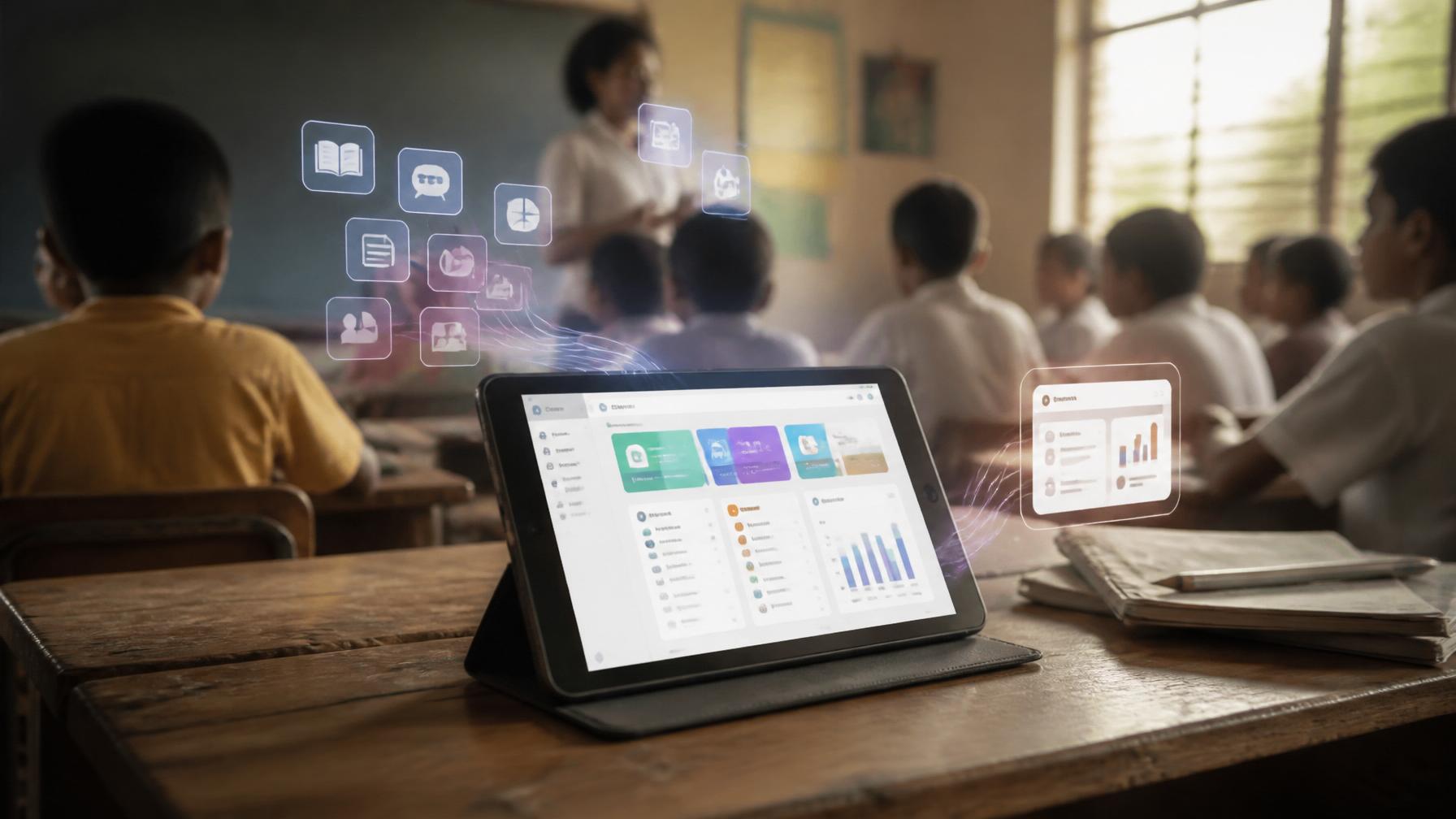
Walk into most digitised classrooms and you will find the same quiet problem: one app for lessons, another for assessment, a third for attendance, a fourth for reporting, each with its own login, its own data, its own moment of failure. Every tool was adopted for a good reason. Together they create a burden no teacher was hired to carry.
The cost of fragmentation is rarely on the invoice. It shows up in the twenty minutes a teacher spends reconciling three systems that do not talk to each other. It shows up when a district cannot answer a simple question — how are our students actually doing — because the answer is scattered across five vendors who never agreed on what a student record looks like. It shows up most sharply where connectivity is thinnest, because every additional app is another thing that breaks when the network does.
An integrated platform changes the arithmetic. When lessons, assessment, and records live in one coherent system, the teacher logs in once. The data follows the student rather than the vendor. A ministry can see the whole picture without stitching it together by hand. And when the connection drops — as it will — the system is designed to keep working and sync later, rather than leaving a classroom stranded.
This is not an argument against choice. It is an argument for coherence as the foundation, with room to extend at the edges. The question a ministry should ask of any education technology is not "what can this app do?" but "what does our system look like when a thousand schools use this every day, on the infrastructure we actually have?"
Built well, technology should disappear into the work of teaching. Teachers should feel supported, not surveilled or burdened. Students should be met with dignity, not treated as data points. That standard is easier to hold when the system is one thing built for the classroom, rather than ten things bolted together and hoping to cohere.